The Box Broke
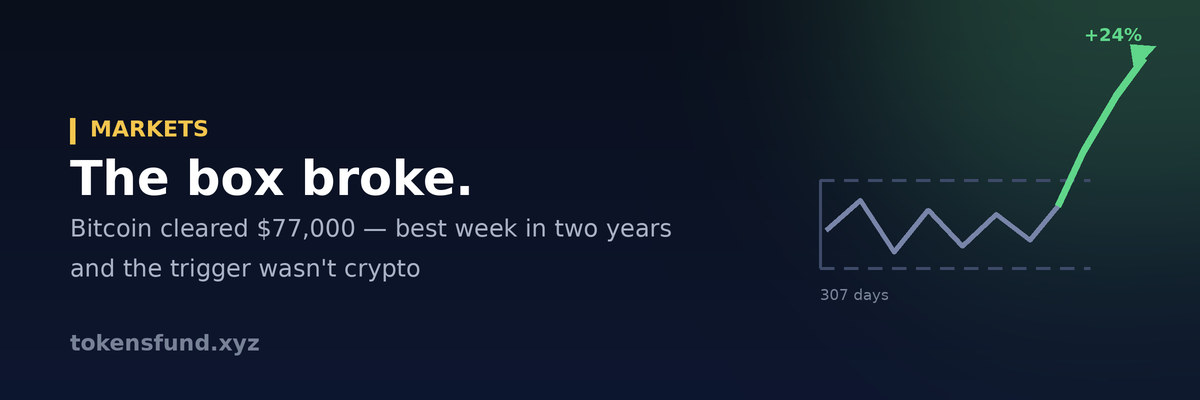
On 12 July we wrote that Bitcoin had spent 307 days inside the same $10,000 box. The piece said two things: that long consolidations always resolve, and that anyone claiming to know the direction was guessing.
It resolved this week. Bitcoin cleared $77,000 on Friday, up roughly 24% since Monday — its best week in more than two years. On 19 August it was trading around $63,000. The range that defined most of a year was gone in four sessions.
What actually caused it
Not a crypto event. The spark was the US Treasury: Secretary Scott Bessent announced the department would double the size of its bond buybacks, which knocked roughly ten basis points off the 30-year yield and, more importantly, was read by markets as a signal about fiscal dominance — the state intervening in its own debt market. The dollar index has fallen about 3% since the end of July. Hard assets responded the way hard assets respond to that.
Two other things landed in the same window. President Trump met crypto industry leaders and publicly urged the Senate to pass the CLARITY Act — the market-structure bill we wrote about stalling in July, and which is still stalled. And spot ETFs took in several hundred million dollars in a day, their largest inflows in months.
But the mechanical amplifier was positioning. More than $1 billion of Bitcoin short positions were liquidated in about an hour, and across crypto a record $2.7 billion of bearish bets were wiped out — the largest liquidation event in the data going back to 2021. Six weeks of compression ended with roughly $3 billion of shorts being forced to buy back into thin supply. That is not the same thing as $3 billion of new demand, and the distinction matters.
What this doesn't prove
The honest caveats, because a green week is when people stop reading them.
- A short squeeze is a mechanism, not a thesis. Forced buying produces violent moves that can retrace just as violently once the fuel is spent. The move was real; the size of it was borrowed from people who were positioned wrong.
- The catalyst was macro, not crypto. Bitcoin rose because of a Treasury bond announcement. That cuts both ways: an asset that rallies on fiscal-dominance signals will also fall on whatever contradicts them. This was not adoption.
- Seasonality is unhelpful from here. This is on track to be Bitcoin's first positive August since 2021, and September has historically been its worst month, averaging roughly −3%. That's a statistical curiosity, not a forecast — but nobody should extrapolate a 24% week into a trend.
- Fear and Greed went from 22 to 72 in about five weeks. The same index that read Extreme Fear when we wrote about builders shipping into the bear now reads Greed. The index measures mood, and mood is the least reliable input available. It was wrong at 22 and it may be wrong at 72.
The part that hasn't changed
Here's what a 24% week doesn't undo. BitMEX still closes next month. BitMart still winds down in January. The Coldcard entropy flaw still drained thousands of BTC from people who did everything right. AscendEX's users are still creditors. Price went up; none of those layers got safer.
If anything, a rally raises the stakes on all of them. Funds that were worth $62,000 a Bitcoin when they got stuck on a failing platform are worth $77,000 now, and still stuck. Rising prices don't improve custody — they just increase what's at risk inside the parts of the system that were already broken.
Which is the same conclusion our July piece reached from the opposite direction. That post argued the boredom phase was for homework: custody sorted, allocations deliberate, keys backed up. The people who did that spent this week watching a number go up. The people who left coins on a venue in wind-down spent it watching the same number and hoping their withdrawal clears.
If you're rotating
A move like this makes people want to rebalance — take profit, rotate into something else, move stablecoins around. The practical note we keep making applies double when markets are fast: you don't have to go back to an exchange to do it. TokensFund compares THORChain, Chainflip, Changee and CCE.Cash on every swap and routes to the best rate, wallet to wallet — no account, no KYC for standard swaps, flat 1% already inside the quote, refunds to your own address if a route can't fill.
And in a week when everything is moving, the boring advice earns its keep: verify addresses character by character, send a test amount first, and be more suspicious than usual of anyone who contacts you about your funds. Rallies bring out scammers the way wind-downs do.
A note on risk
Nothing here is financial advice. Prices and figures reflect reporting as of 21 August 2026 and are moving quickly; sources differ slightly on the weekly percentage and the precise high. Short-liquidation data is exchange-reported. Nothing in this article predicts direction — the July piece said long consolidations resolve unpredictably, and this week is evidence for that claim, not against it. Position sizes should survive being wrong.
Rotate without going back to an exchange
Compare routes →