Bitcoin Has Spent 307 Days in the Same $10K Box. Here's What Long Consolidations Actually Mean
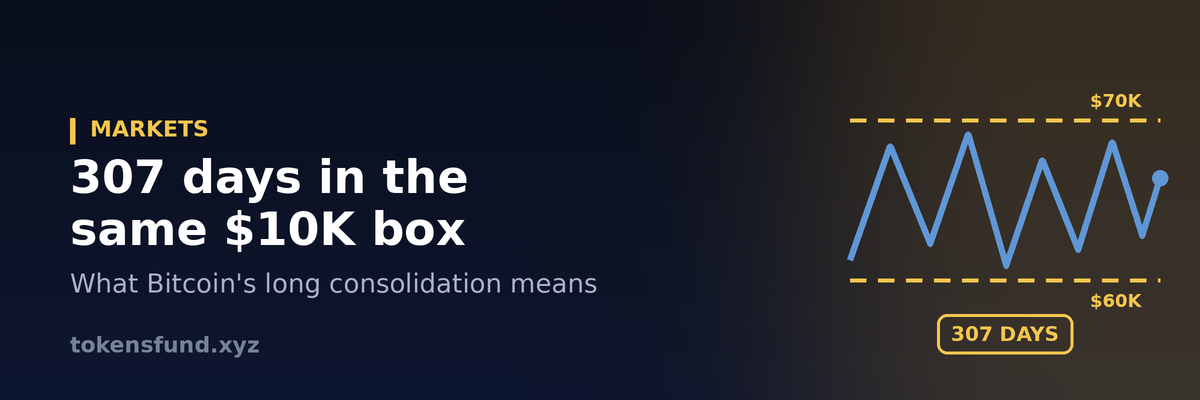
Here's a stat that reframes the whole year: per market data flagged this week, Bitcoin has now spent 307 days trading inside the $60,000–$70,000 band — making it the third most-traded $10,000 range in Bitcoin's entire history. Not the third this cycle. The third ever.
Think about what happened inside those 307 days. The all-time high at $126,000 became a memory. Fear & Greed printed a 12. Spot ETFs had their worst month in history — $4.5 billion out in June alone — then flipped to inflows, then flipped back. MiCA redrew the European exchange map, took an exchange down with user funds inside, and the crypto IPO class lost up to 89% of its value. Strategy sold coins for the first time since 2022. A memecoin named after a trader resurrected an entire launchpad.
All of that drama — institutional panic, regulatory upheaval, a full sentiment cycle — and the price is back inside the same box it's occupied since last year. This week it's at $64,400, testing the same resistance it failed at on Monday, with the June peak of $67,250 above it and the box top at $70,000 above that.
What a 307-day range actually is
A consolidation this long isn't the market doing nothing. It's the market changing hands. Every day inside the range, coins move from people who've lost conviction to people who haven't — sellers exhausting into buyers absorbing. The technical term for the debate is accumulation versus distribution: is smart money quietly stacking before the next leg up, or quietly exiting before the next leg down? The honest answer — the one you won't get from anyone selling a course — is that you can only tell which it was afterward, by which way the range breaks.
What history does say clearly: the longer volatility compresses, the more violently it tends to resolve. Ranges this mature don't usually end with a gentle drift — they end with a decisive break, and 307 days of positioning unwinds fast in whichever direction that is. The levels the market is watching are no secret: hold above $64,000 and the path opens toward $67,250 and the top of the box; lose the high-$50,000s support and analysts' bear cases — Citi's trimmed $82K target on one end, Galaxy's $40–46K warning on the other — start getting quoted a lot more.
We're not going to pretend to know which way it goes. Neither does anyone else. That's precisely the point of what follows.
The boredom phase is the homework phase
Long ranges are where good portfolio habits get built, because they're the only time the market isn't rushing you. The things experienced holders actually do in month ten of a sideways grind:
- Get custody right, unhurried. Nobody sets up a hardware wallet well during a 20% daily candle. A quiet market is when you move coins off exchanges properly — test transactions, seed backups, no adrenaline. This year already provided the case study for why idle exchange balances are uncompensated risk. Our self-custody guide is the walkthrough.
- Rebalance deliberately. Ranges are when rotation is cheap — trimming what overgrew, adding what lagged, adjusting the BTC/ETH/stables mix to what you can actually hold through a violent break in either direction. The time to decide your allocation is before the box resolves, not during.
- DCA without drama. If your thesis is long, a sideways year is mechanically the friendliest environment dollar-cost averaging ever gets — the same money keeps buying the same range instead of chasing.
- Position for both outcomes, not one. The range will break. If you'd panic on a break down, your allocation is too heavy now. If you'd have nothing to deploy on a break up, too light. Boredom is when you fix that — calmly.
Every one of those is a wallet-to-wallet move, not an exchange-account move. TokensFund handles the swap part non-custodially: it compares THORChain, Chainflip, Changee and CCE.Cash and routes to the best rate — no account, no KYC for standard swaps, flat 1% already in the quote, automatic refund to your own address if a swap can't fill. Rotate the mix; keep the keys.
A note on risk
Nothing here is financial advice, and the honest core of this piece bears repeating: long consolidations resolve in either direction, usually fast, and anyone claiming certainty about which way is guessing with confidence. Figures are as of July 12, 2026 and move daily. Position so that both outcomes are survivable, and make custody decisions on your own quiet timeline — that's the one part of this that's fully in your control.
Do the boredom-phase homework
Rebalance wallet-to-wallet →