Fear & Greed Hit 12: The Bear-Market Case for Self-Custody
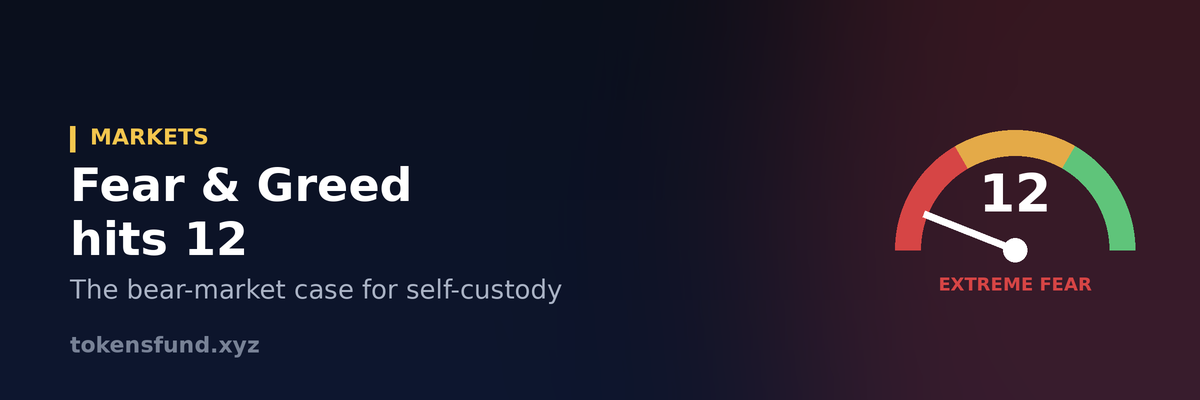
The mood in crypto right now is about as dark as the gauge goes. As of June 25, 2026, the Crypto Fear & Greed Index has fallen to 12 out of 100 — deep in "Extreme Fear" and near its all-time lows, down from 24 just two days earlier. It dropped there as Bitcoin briefly broke below $60,000, hitting its lowest levels in years, with Ethereum following it down.
When fear runs this hot, two instincts kick in: panic-sell, or freeze. But there's a third move that matters more than either — making sure that whatever you hold, you actually control. Bear markets are exactly when custodial risk turns from abstract to real.
Why fear markets are when custody matters most
Volatility stress-tests exchanges. Sharp drawdowns bring liquidation cascades, congested withdrawals, paused trading, and — in the worst cases — the kind of solvency failures that have wiped out users before. The pattern of past cycles is consistent: when prices crash, the platforms holding everyone's coins are where the trouble concentrates. If your assets are sitting on an exchange, your access to them depends on that exchange staying solvent and online precisely when it's under the most strain.
Self-custody removes that dependency. Coins in a wallet you control can't be frozen by a withdrawal halt, lost to a platform insolvency, or locked behind a support ticket. The phrase is old for a reason: not your keys, not your coins.
The other side: fear is a sentiment gauge, not a signal
It's worth being honest about what an "Extreme Fear" reading does and doesn't tell you. Historically, single-digit and low readings have more often lined up with accumulation zones than the start of fresh capitulation — sentiment extremes tend to mean-revert. But the index measures emotion, not bottoms. Fear can stay extreme for weeks, and there's a real macro backdrop here — ETF outflows and money rotating into AI equities — that won't resolve because a needle moved. Treat it as context, not a buy button. Plenty of people have caught falling knives buying "extreme fear."
Positioning without handing over custody
Whatever you decide — wait, rotate into stablecoins, or accumulate — you can do it without parking your funds on a custodial platform. That's where a non-custodial swap comes in. TokensFund compares rates across THORChain, Chainflip, Changee and CCE.Cash and routes your swap to the best one, wallet to wallet. It never holds your funds, there's no account, and no KYC for standard swaps — so you can move between assets while staying entirely in self-custody.
- ✅ Rotate to stables or majors without depositing to an exchange
- ✅ Non-custodial — your keys, the whole way through
- ✅ Best rate across four protocols in one click
- ✅ Automatic refund to your own address if a swap can't fill
How to swap while staying in self-custody
- Go to tokensfund.xyz
- Pick what you're sending and what you want to receive
- Enter the amount — the live estimate updates instantly
- Enter your own receiving address, then a refund address
- Click "Compare routes" and choose the best rate
- Send to the one-time deposit address — funds land in your wallet automatically
More on the reasoning: why non-custodial swaps protect your privacy and your funds.
A note on risk
Nothing here is financial advice. Crypto is volatile, "extreme fear" can persist or deepen, and self-custody carries its own responsibility — if you lose your keys, no one can recover them for you. The market figures above are as of June 25, 2026 and change quickly. Manage your own risk.
Stay in control of your crypto
Swap in self-custody →