Two Exchanges Announced Their Deaths in One Week. Read the Exit Terms Side by Side
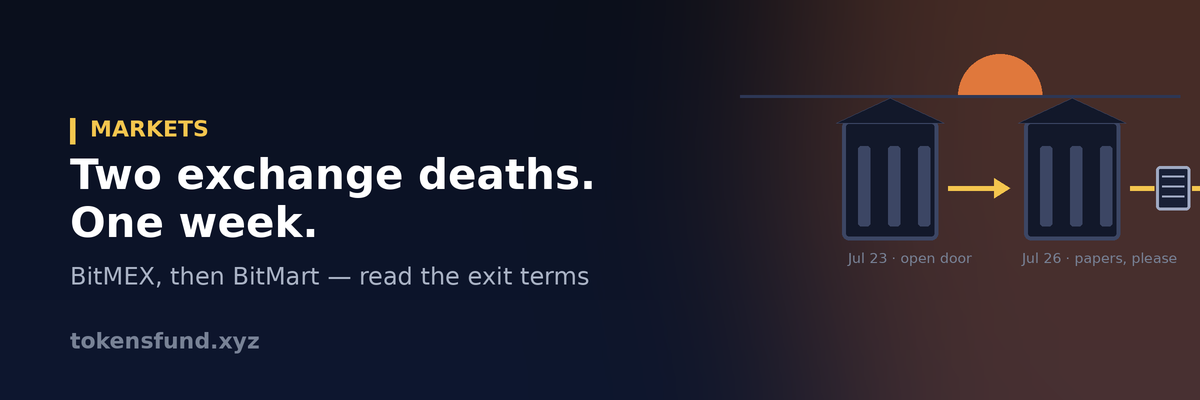
On July 23, BitMEX — the inventor of the perpetual swap — announced its closure. Three days later, this morning, BitMart followed: an "orderly wind-down" after "careful evaluation of the Company's operating conditions, market environment, and future strategic direction." Registrations, deposits, and new orders begin suspending today; all trading ends August 26; the platform ceases entirely on January 31, 2027.
One closure is a story about a company. Two in seventy-two hours is a story about the layer. And reading the two wind-down notices side by side teaches more about custody than any thousand-word warning we could write — because these are the orderlyendings, the good ones, and they still differ in a way every exchange user should see.
The week's tally, and the year's
Zoom out before zooming in. In 2026 so far: MiCA's licensing wall cleared roughly 7% of Europe's crypto firms. AscendEX collapsed with user funds inside. The listed crypto companies trade 70–90% below their debuts. And now, in one July week, two long-running exchanges — the derivatives pioneer and a retail altcoin venue that once reported nine million users — have scheduled their own endings, both citing strategy and market conditions rather than any crisis. Days ago we wrote that the coins are walking. This week, the venues started holding the door.
Two orderly exits, two very different doors
Credit first, as always: both notices are responsible documents. Both give timelines. Both warn loudly about phishing — no "expedited withdrawal" services exist, nobody legitimate will ever ask for your keys or codes. Both are the opposite of the AscendEX trapdoor. If every exchange died this politely, custodial risk would be a smaller topic.
Now the difference. BitMEX's exit terms are about throughput: withdraw any time, expect queues from its fixed address pool, assets exceed liabilities per its proof-of-reserves page. BitMart's Section II is about clearance. Before your withdrawal is processed, the notice says requests "may be subject to further review" including: verification of KYC information; login devices and IP addresses; the withdrawal address itself; the source of your funds and trading history; Travel Rule and sanctions screening; and "where necessary," documentation up to and including proof of ownership of the withdrawal address. Users are told to "complete or update identity verification" as step two of leaving. Submitting a withdrawal request, the notice clarifies, "does not mean the review has been completed."
To be scrupulously fair: most of that list is standard AML machinery that large custodial exchanges apply to flagged withdrawals every ordinary day, and BitMart presenting it transparently is better than springing it silently. But that's precisely the lesson. We called custodial platforms data honeypots for what they accumulate. A wind-down shows you the other face of the same machine: when everyone heads for the exit at once, the compliance layer stands between every single user and their own coins — identity, device history, source of funds, papers for the wallet you're withdrawing to. Your assets, released upon presentation of documents, on a timeline the reviewer controls.
What we don't know, said plainly
Neither company has given a fuller "why" than strategy and market conditions, and we won't invent one. BitMart's notice makes no insolvency admission and says withdrawals remain available — take that at face value. What can be said factually: its recent announcement history shows a platform trimming for months (margin trading discontinued, market-making bots suspended, a U.S.-services notice, custody fees for inactive accounts), and unlike BitMEX, today's notice references no proof-of-reserves page. Draw conclusions carefully; better yet, don't draw them — act on the part that isn't uncertain, which is the calendar.
If you have funds on BitMart
The notice's own advice is correct and urgent: deposits suspend starting today — send nothing to BitMart addresses from here on, as late deposits "may not be automatically credited." Close positions and submit withdrawals well before August 26; the recommended window is now, not the deadline, because review queues grow with the crowd. Verify networks and destination addresses twice — a wind-down is the worst possible time for a wrong-chain deposit. Download your trade and transaction history while the interface exists; you may want it for taxes long after January 31. And treat every DM, Telegram message, or "priority processing" offer as the scam BitMart explicitly warns it is.
Then the standing question, sharper after this week than ever: withdrawn to your own wallet — how do you keep managing a portfolio without depositing onto the next venue that will someday publish one of these notices? That's the gap TokensFund closes: swaps compared across THORChain, Chainflip, NEAR Intents, Changee and CCE.Cash, executed wallet to wallet — no account, no KYC for standard swaps, flat 1% in the quote, automatic refund to your own address if a swap can't fill. No balance sitting anywhere that can schedule a closure, gate your exit, or ask for papers to release what's yours. Start with the self-custody guide if you're making the move for the first time.
A note on risk
Nothing here is financial advice. Details are from BitMart's and BitMEX's official notices as of July 26, 2026; wind-down terms can be updated and the companies' own channels are authoritative. No insolvency is alleged of either platform. Self-custody transfers risk to you rather than removing it: back up keys, verify addresses, send test amounts — and during wind-down season, assume anyone who contacts you first about your funds is lying.
No closure dates. No exit reviews. Your keys.
Swap wallet-to-wallet →