While Washington Debates Stablecoins, 100 Million People Already Use Them as Bank Accounts
Two things happened this month that belong in the same sentence, and almost nobody put them there.
The first: per reporting this week, US regulators missed the GENIUS Act's July 18 deadline for final stablecoin rules. Reserve requirements, exchange compliance, issuer obligations — all still unsettled, with enforcement scheduled for January 2027. It's the same pattern we described in the CLARITY Act piece: not a decision against, just an absence of decision.
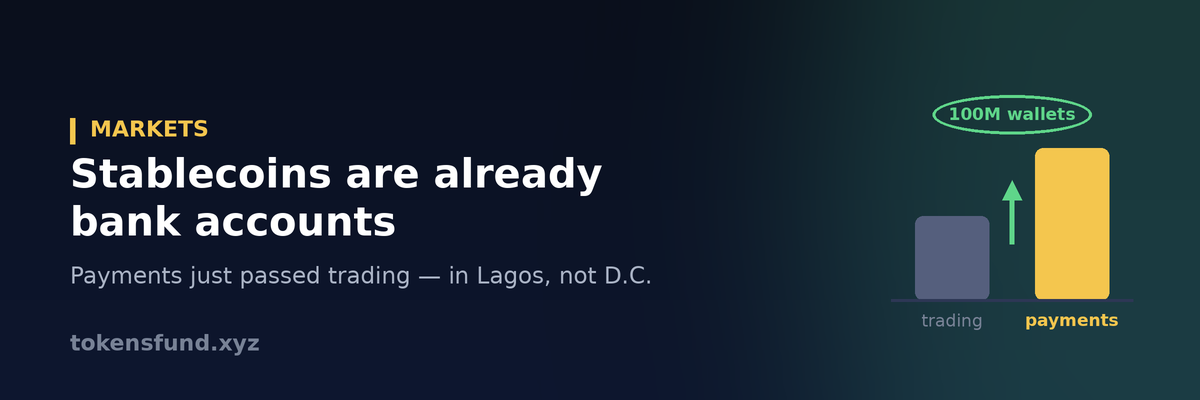
The second: a self-custodial crypto wallet announced it crossed 100 million users — and that for the first time in its history, daily payment users outnumbered traders. Not speculators. People paying for things.
The numbers behind the milestone
Bitget Wallet's figures, released alongside that milestone, describe a product that quietly stopped being a trading tool:
- More than half its users are in Southeast Asia, South Asia, Africa and Latin America, using wallets as dollar accounts to save, receive income, and spend locally.
- 150,000+ cards issued across 50+ markets, spendable at 150M+ merchants.
- Global card spending of $31M in H1 2026, up 191% from the previous half-year. In emerging markets specifically, spend rose 416% — from roughly $422,000 to $2.2M.
- Cardholders averaged 9.4 transactions per month at about $28 a purchase. That's not crypto tourism; that's debit-card behavior — groceries, top-ups, the ordinary stuff.
- The settlement layer behind it claims 80+ payment rails across 100+ currencies and more than $177B in stablecoin volume settled.
The why isn't mysterious, and it has nothing to do with ideology. Nigeria's naira lost over 40% against the dollar in 2024; Argentina's peso lost a comparable share. Conventional remittance corridors into those markets still charge 5–8% per transfer. Against that, a wallet holding dollar-denominated tokens that settles in minutes for cents isn't a crypto position — it's the better checking account. Capital has noticed too: Tether just put $20M into Mercado Bitcoin, Brazil's largest exchange.
The honest half
Now the parts a press release won't volunteer, because this milestone came from a press release.
These are self-reported numbers. "100 million users" is a registration count published by a company with an interest in the narrative, not an audited figure, and it isn't the same as 100 million active users. Treat the direction as real and the precision as marketing.
The absolute size is still small. $31M of card spend across six months is a rounding error next to traditional payments — Visa processes more before breakfast. What's meaningful is the slope and the behavior (9.4 transactions a month), not the total.
And the card is where KYC comes back. This is the part worth underlining. The wallet is genuinely self-custodial — your keys, your tokens. But the moment you attach a Visa or Mastercard rail to it, you complete identity verification, and your spending flows through the same monitored payment system as everything else. Self-custody of the asset is not privacy of the transaction. Anyone reading "non-custodial wallet with a card" as "financial anonymity" has misread the product.
Stablecoins carry issuer risk that BTC doesn't. A dollar token is a liability of a company that can freeze addresses, and both major issuers have done it. We covered the flow shift in the flippening data, and the regulatory whiplash in the MiCA delistings — where the very instrument being adopted as banking infrastructure in Lagos was being pushed off licensed venues in Lisbon. A stablecoin bank account is still a bank account with someone else's kill switch attached; it just has better uptime than the naira.
What this actually tells you
Strip the marketing and a real signal remains: crypto's center of gravity is moving from trading to holding and spending, and it's moving fastest where the local currency is failing. That inverts the usual story. The rules are being drafted in Washington and Brussels; the usage is being decided in Lagos, Buenos Aires, Manila and Dhaka — by people who aren't waiting for a deadline that just got missed anyway.
For anyone whose wallet is becoming their primary account, the practical questions stop being about entry price and start being about mechanics: keys backed up properly, and the ability to move between assets without asking permission. Our self-custody guide covers the first. The second is what we build: TokensFund compares THORChain, Chainflip, Changee and CCE.Cash and routes your swap to the best rate, wallet to wallet — no account, no KYC for standard swaps, flat 1% already in the quote, automatic refund to your own address if a swap can't fill.
That includes the move this data implies for anyone thinking a step ahead: rotating part of a stablecoin balance into an asset with no issuer and no freeze function — BTC, or XMR if privacy matters to you — is a swap, not an application. If stablecoins are your checking account, those are the savings that nobody can switch off.
A note on risk
Nothing here is financial advice. The wallet figures cited are company-reported and unaudited; the GENIUS Act timeline reflects reporting as of July 20, 2026 and may move. Stablecoins carry issuer, reserve and regulatory risk that varies by jurisdiction, and rules on holding or spending crypto differ by country — you're responsible for following the ones where you live. Self-custody transfers risk to you rather than removing it: back up your keys, verify addresses, send test amounts.
An account nobody can freeze
Swap wallet-to-wallet →