Why We Removed NEAR Intents
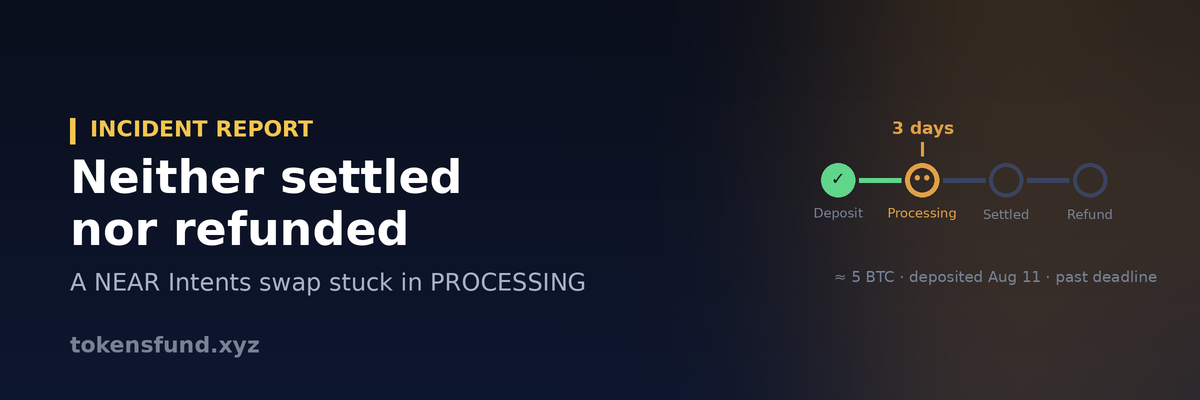
This started with a BitcoinTalk user, not with us. He reported that roughly 5 BTC — about $320,000 at the time — had been sitting in a NEAR Intents (1Click) cross-chain swap since 10 August with no resolution. We looked at what he could show publicly, helped him document it, and published this because private channels weren't producing anything.
We are not the affected party and we hold none of the funds. We publish it because we integrated the provider and our users deserve to know when a route we offer behaves this way.
The facts, as far as they can be verified publicly
- What: a NEAR Intents (1Click) swap of approximately 5 BTC.
- When: the order entered
PROCESSINGon 10 August 2026. - Deposit address:
bc1qh24lnnls8fpp90vttch8zwdkeetvvkdfnt3rry - State: the public 1Click status endpoint reported
PROCESSINGwith an emptyintentHashesfield. Per 1Click's documentation that status means the deposit was detected and passed to solvers — so this was not a deposit-detection problem. - Outcome: no destination-chain transaction, no refund, and the execution deadline long expired.
- Context: the same user completed two earlier swaps through the same service without issue, so this was not a first-time configuration mistake.
- Support: a ticket was opened and acknowledged, the case was escalated to a technical team, and then multiple follow-ups produced no substantive answer, no timeline and no refund date. A public message asking for one was deleted, and the account was subsequently restricted from posting in the official Telegram group.
What the documentation says should happen
1Click's documentation describes two possible endings: the swap succeeds and tokens are delivered, or it fails and funds are refunded automatically to the refund address supplied at quote time. Automatic retries and refund handling are listed as built-in features. A swap that sits in PROCESSING for days past its deadline, delivering neither outcome, is not a state the documented design accounts for.
What we do not know
- We do not allege theft or misappropriation. Nothing publicly visible supports that and we are not claiming it. A solver failure, an internal error, a stuck settlement leg or a manual compliance review are all consistent with what can be seen from outside.
- We cannot see the internal state. A status string is not a diagnosis. Only NEAR Intents can say what actually happened to this intent.
- Delays are not always failures. Cross-chain settlement can legitimately take time. Days past deadline with no refund and no answer is what moves this from slow to unresolved.
Why we removed the provider
After publishing, we found independent reports describing a strikingly similar pattern: deposits confirming on-chain but never crediting, funds visible at the generated deposit address, support escalating and then going quiet, and users restricted from asking about it publicly. One described a compliance review with no timeline and a request to send source-of-funds documentation. We cannot verify other people's accounts, and we note that reviews are unverified by nature — but the pattern matched closely enough that we were no longer comfortable routing anyone to it.
So we stopped. Not as a judgement on the protocol's technology, and not as an accusation — as a decision about where we are willing to send other people's money while a case like this is open. If it is resolved and the underlying failure is explained, we will reconsider, and we will say so here.
What this means for TokensFund users
- Nothing routes to NEAR Intents any more. Quotes, deposits and tracking for that provider are all removed.
- ZEC is unavailable for now. NEAR Intents was our only Zcash route. THORChain has announced a ZEC pool but it is not live yet; we will restore Zcash when it is. We would rather drop an asset than keep a route open that we do not trust.
- Everything else is unaffected. THORChain, Chainflip, Changee and CCE.Cash continue to quote and settle normally.
- Always set a refund address, on any service. It is the only mechanism that returns funds without anyone's intervention.
- Test with a small amount before moving size through any route, on any aggregator including ours. It is the cheapest insurance in crypto.
- Non-custodial does not mean nothing can go wrong. We never hold your funds — but the protocols we route to are independent systems that can fail. When they do, we would rather say so plainly than quietly hope you don't notice.
Why we published at all
We have spent this year writing about exchanges that wind down, platforms that fail with user funds inside, and hardware that ships flawed. It would be inconsistent to hold others to a standard of public disclosure and stay quiet when a route we integrated left someone's funds unresolved. This post will be updated if the situation changes in either direction.
A note on risk
Nothing here is financial or legal advice. This report reflects publicly verifiable information and the affected user's account as of August 2026. No allegation of wrongdoing is made against NEAR Intents, NEAR Protocol or any other party. Status descriptions are drawn from 1Click's public documentation and API responses. We will update or correct this post as facts develop.
Four routes, compared — so you can choose
Open the swap terminal →