What Monero Price Predictions Actually Tell You
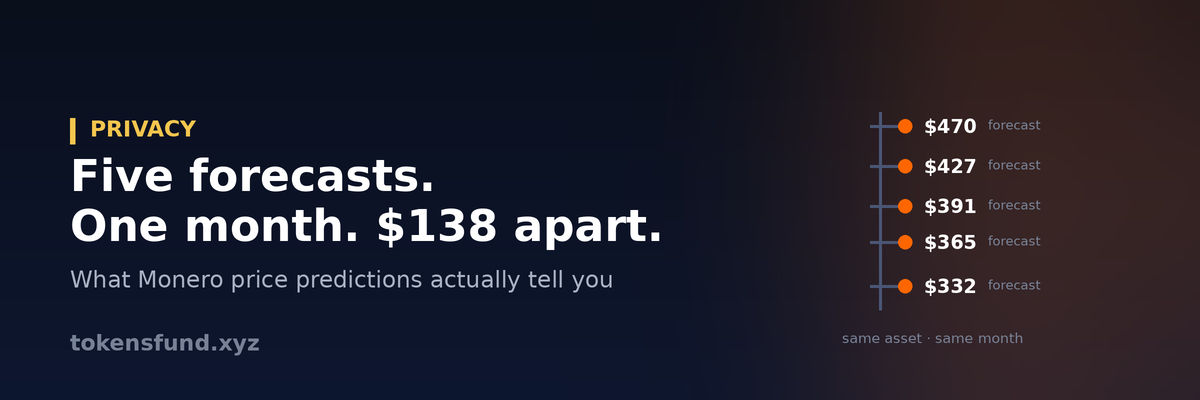
Search "Monero price prediction" and you get a wall of confident numbers. We read them. Here is what they said about the same asset over the same month:
- One site: a maximum of $470 for August.
- Another: a target of $427, from a cup-and-handle pattern.
- Another: a range of $355 to $391 for the final week.
- Another: a minimum of $332 and an average of $365.
Extend the horizon and it gets worse. End-of-2026 targets in circulation include $825 and figures above $1,000. Long-term "ceilings" range from $800 to $1,300. One model projects $1,753 by 2032, which is a number with four significant figures attached to a date six years away.
These cannot all be right. Most will be wrong. And the spread between them — not any individual figure — is the only genuinely informative thing in the set: it is a direct measurement of how little anyone knows.
Why they disagree so much
Because most of them aren't forecasts in any meaningful sense. Three things are being passed off as one:
- Trend extrapolation. Take the recent slope, extend it forward, publish a table by month through 2032. This produces smooth, confident-looking numbers that encode no information about the future at all — only about the recent past.
- Chart pattern targets. More honest, because they usually state an invalidation level. A measured move from a cup-and-handle is a conditional statement: if this level holds, then that target. Stripped of the condition — as it usually is in the headline — it becomes a prophecy.
- SEO inventory. A large share of this content exists because the query has volume. The numbers are the product, not the analysis.
You can spot the difference quickly. A useful piece of analysis names what would make it wrong. A prediction that only describes the upside is marketing.
What actually moves Monero
Ignore the targets and there are real, describable forces here — which is why this asset is more interesting than the forecasts about it.
Supply is unusual and permanent. Monero has no hard cap. It uses tail emission: a fixed 0.6 XMR per block, indefinitely. That is a deliberate design choice — it guarantees miners are paid forever rather than relying on a fee market that may never materialise, which is Bitcoin's open long-term question. The practical effect is a small, predictable, and steadily decreasing percentage inflation as the base grows. Anyone modelling XMR without accounting for tail emission is modelling a different asset.
Liquidity is fragmented by design of others. Years of delistings pushed XMR off most large custodial venues. That doesn't reduce demand; it relocates it — to instant exchangers, peer-to-peer, and non-custodial routes. The visible order-book depth on regulated venues understates the real market, which is part of why XMR's price behaviour often looks disconnected from what a screen-watching trader expects.
The routing map is changing right now. THORChain's v3.20 release brings native XMR support to a decentralised protocol — swaps against BTC and stablecoins with no company holding funds mid-trade. If those pools mature, it is the first time in years the liquidity trend for Monero has run in the opposite direction to the delistings. That is a structural development worth watching, and it is more consequential than any monthly target.
And privacy demand is not a price signal. The reason people buy Monero — transactions nobody can trace — doesn't show up in a chart pattern. It shows up slowly, in usage, and it is largely indifferent to whether the token is at $350 or $470.
The one number worth holding on to
If you want a single figure that tells you something, it isn't a target. It is this: XMR trades roughly 49% below its January 2026 all-time high near $711–$798, with a market capitalisation in the region of $6–8 billion.
That says something concrete. It says the asset had a run and gave most of it back, that it remains small enough that its price is highly sensitive to flows, and that anyone quoting you a 2032 target is extrapolating from a base that has moved ±50% within a single year. Small, volatile, structurally in demand, and unusually hard to buy. Those four facts are more useful than any of the numbers above, and none of them expire next month.
What we'd actually suggest
We aren't going to give you a target, because we don't have one and neither does anyone else. What we'd suggest instead:
- Decide your reason for holding before you decide your size. "I want private, self-custodied money" and "I think this goes to $800" are different theses with different correct position sizes and different exit conditions.
- If you're buying for privacy, the storage matters more than the entry. XMR on an exchange is a privacy coin with your name attached to it. The point of the asset is defeated at the custody layer, not the price layer.
- Compare routes when you do buy. Because of the liquidity fragmentation described above, quotes for the same XMR trade differ more between services than for almost any other pair — often by more than a percentage point. That gap is real money and it is the one thing you can actually control.
Which is what we built: TokensFund compares THORChain, Chainflip, Changee and CCE.Cash on every swap and routes to the best rate, wallet to wallet — no account, no KYC for standard swaps, flat 1% already inside the quote. Our BTC→XMR rate guide explains what actually moves a quote, and the step-by-step walkthrough covers the mechanics.
A note on risk
Nothing here is financial advice, and nothing here is a price prediction. Figures cited are drawn from published forecasts and market data from August 2026 and are quoted to illustrate their disagreement, not to endorse any of them. Monero is volatile, and its regulatory treatment varies by jurisdiction — you are responsible for following the rules where you live. Size positions so that being wrong is survivable.
Compare XMR routes before you buy
Compare BTC → XMR →