KuCoin Delists Monero on November 30. The Exchange Era of XMR Is Almost Over
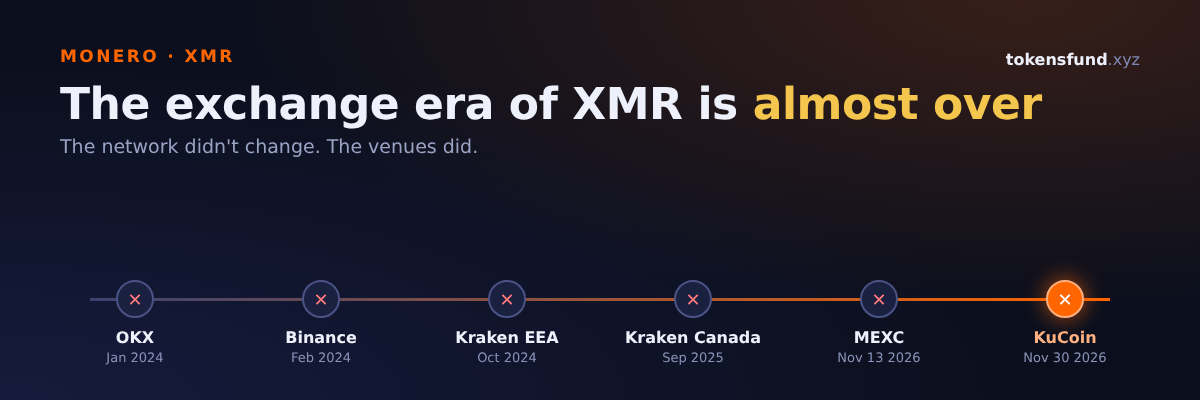
KuCoin has announced that it will end Monero trading on November 30, 2026. XMR deposits are already switched off and won't come back. For years KuCoin was the venue people pointed to when someone asked where you could still buy Monero on a big exchange. That answer is about to expire.
It also arrives barely two weeks after MEXC removed its XMR spot and perpetual markets on November 13, which until then held one of the deepest XMR order books left on any centralized exchange.
The timeline
- OKX — delisted XMR (alongside ZEC and DASH) on January 5, 2024.
- Binance — delisted XMR on February 20, 2024, and later converted leftover balances to USDC.
- Kraken (Ireland and Belgium) — halted XMR trading and deposits in June 2024.
- Kraken (entire EEA) — ended XMR on October 31, 2024; balances left behind were force-converted to BTC.
- Kraken (Canada) — disabled XMR trading for Canadian clients on September 2, 2025.
- MEXC — removed XMR spot and perpetual markets on November 13, 2026; open positions were force-closed.
- KuCoin — spot trading ends November 30, 2026.
A handful of exchanges still list XMR, mostly with heavy geographic restrictions or identity checks on withdrawals. The direction is not in doubt.
If you hold XMR on KuCoin: the dates that matter
Per KuCoin's announcement:
- November 27, 12:00 UTC — XMR leaves Flexible Savings; principal and earnings move to your Funding Account.
- November 30, 03:00 UTC — Convert stops supporting XMR.
- November 30, 06:00 UTC — XMR trading bots are removed.
- November 30, 08:00 UTC — spot trading ends on XMR/USDT, XMR/USDC, XMR/ETH and XMR/BTC.
- After November 30 — XMR no longer counts as loan collateral. Borrowers above the required loan-to-value ratio can be liquidated.
- December 31 — the last day for withdrawals, and KuCoin says it may close them earlier.
The practical step is simple: withdraw to a Monero wallet you control, and do it early rather than on the last day. Balances left on an exchange after a delisting tend to end up converted into something else at a rate and time you don't choose — Binance and Kraken both did exactly that. Some reports say KuCoin requires a higher verification level for privacy-coin withdrawals, so check your account now rather than discovering it in late December.
Why the exchanges are leaving
Not because Monero stopped working. The exchanges rarely give a detailed reason, but the pressure is regulatory and it is getting more explicit. The EU's Anti-Money Laundering Regulation bars regulated crypto firms from holding or offering "anonymity-enhancing coins" from July 2027. An exchange that wants licences in Europe, or banking relationships anywhere, has to show that it can trace every transaction it processes. Monero is designed so that nobody can do that. The two goals are incompatible, and the exchanges have picked the licence.
It's worth being precise about what that means. A delisting changes who sells you Monero. It changes nothing about the network: blocks keep coming, wallets keep working, transactions stay private. If anything, it confirms that the privacy is real. Nobody delists a coin for being easy to trace.
Where XMR is traded now
The volume didn't vanish. It moved to places that never needed a compliance desk to begin with:
- Peer-to-peer markets — buyers and sellers trade directly, usually with escrow. They are the most private option but also the slowest, and they carry their own risk: Haveno-based network RetoSwap suspended trading in May 2026 after a $2.7 million exploit. Check a market's status before you use it.
- Atomic swaps — BTC-to-XMR trades enforced by cryptography, with no counterparty holding funds. Trustless, but slower and limited in pairs and size.
- Instant swap services — you send one coin and receive XMR at your own address, wallet to wallet, usually in under an hour and without an account.
The last category is where most everyday volume goes, because it's the closest thing to the old exchange experience without the custody. It is also what TokensFund does: we compare live quotes from every route that currently supports your pair and send your swap to the one you pick. No account, no KYC for standard swaps, and no TokensFund fee. You can go straight from BTC to XMR, USDT (TRC-20) to XMR or ETH to XMR, and back again with XMR to BTC. Our step-by-step BTC to XMR guide walks through the whole process.
The honest half
Leaving the exchanges has real costs, and pretending otherwise doesn't help anyone. Prices on instant-swap routes include a spread, so a large order can cost more than it did on a deep exchange order book. Liquidity is thinner, which means very large swaps may need to be split. And a fiat on-ramp straight into XMR is now genuinely hard to find — most people will buy BTC, USDT or another major coin first and swap from there.
Exchange custody was never the safe option it looked like, though. Every delisting on this list came with a deadline, a forced conversion or a frozen balance for someone who didn't act in time. If you hold Monero, the delistings make the old advice unavoidable: keep it in a wallet where you hold the keys. Our guide to moving crypto off an exchange covers how.
Privacy was never going to live comfortably on a centralized order book. The delistings just made that official.
A note on risk
Nothing here is financial advice. Dates are taken from KuCoin's announcement and public reporting as of November 26, 2026; check KuCoin's own notice for any changes. Exchange availability of XMR differs by country and changes often. Rules on holding and trading privacy coins vary by jurisdiction, and you are responsible for following the ones where you live. When moving funds, verify addresses carefully and consider a small test transaction first.
Monero, wallet to wallet
Compare XMR routes →