Japan Is Doing the Opposite of Europe. Regulation Has Two Blades
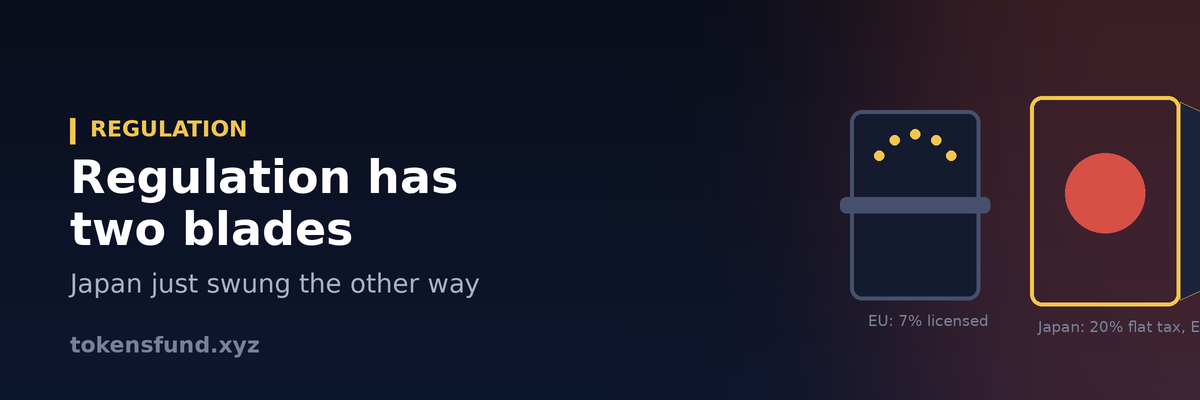
For a month, this blog has documented one blade of crypto regulation. MiCA's deadline pushed the world's biggest exchange and biggest stablecoin out of Europe, licensed roughly 210 of 3,000+ firms — about 7% — and took one exchange down with user funds inside. Regulation as chokepoint: doors closing, access narrowing, users told to move or lose.
Today, the other blade. Japan's Upper House committee approved landmark legislation that goes the opposite direction on nearly every axis: cryptocurrencies reclassified as financial instruments under the Financial Instruments and Exchange Act — the same legal family as stocks and bonds — crypto taxes cut from a progressive rate reaching 55% to a flat 20%, and a path cleared for spot Bitcoin ETFs to list on the Tokyo Stock Exchange as early as 2027. Bitcoin touched $65,000 for the first time in three weeks within hours, helped along by the softest U.S. inflation print since 2020.
What Japan actually voted for
Three changes, each significant on its own:
- Legal status. Financial-instrument classification ends crypto's decade in Japan's regulatory gray zone. It brings disclosure standards and investor protections — and, in the same stroke, legitimacy: an asset class the law treats like securities is one that pensions, brokers and banks can touch.
- The tax cut is the real unlock. Japan has taxed crypto gains as "miscellaneous income" at progressive rates up to 55% — among the harshest in the developed world, and the reason a generation of Japanese traders either never realized gains or left the country. A flat 20% puts crypto on par with stock gains. That single line changes the calculus for millions of holders.
- ETFs by 2027. The world's fourth-largest economy joining the spot-ETF map — a year-plus away, but now a matter of implementation rather than possibility.
Same month, opposite directions
Hold the two side by side. Europe: a licensing wall that 93% of firms didn't clear, delistings, an exchange failure, users advised by the regulator itself to consider self-custody. Japan: legal legitimacy, a tax invitation, and new regulated on-ramps. Both are "regulation." They cut in opposite directions — and that's the point this blog would be dishonest to skip. If we only ever showed you the closing doors, we'd be selling you a worldview instead of telling you what's happening. Regulation isn't a monolith. It's a blade that swings both ways, on political timelines nobody can predict, differently in every jurisdiction.
The honest caveats
Before anyone books a flight to Tokyo: this is a committee approval, not yet law — it still needs passage by the full chambers and then implementation rulemaking, where details can tighten. The ETFs are 2027 at the earliest. Financial-instrument status cuts both ways too: it likely brings insider-trading rules, disclosure duties, and the kind of supervision Japan has applied with famous strictness since Mt. Gox and Coincheck — Japan is opening the door, not removing it. And when those ETFs arrive, remember what they are: paper claims on BTC, with all the wrapper mechanics we watched play out in the U.S. this summer.
The through-line that survives both blades
Here's what a month of covering both directions actually teaches. What regulation changes — in either direction — is access through intermediaries. Licensed venues open or close. Assets get listed or delisted. Tax rates on realized gains double or halve. Wrappers appear and disappear. Every one of those swings happens at the layer between you and the asset.
Coins in a wallet you control sit below that layer. They worked the same in Europe the week MiCA closed the doors, and they'll work the same in Japan the year the doors open wide. Self-custody isn't a bet that regulation turns hostile — Japan just proved it sometimes turns friendly. It's indifference to the swing. That's the position that doesn't need to predict the next committee vote, in any parliament, ever.
TokensFund is built for that position: non-custodial swaps across THORChain, Chainflip, Changee and CCE.Cash, best rate wins, wallet to wallet. No account, no KYC for standard swaps, flat 1% shown in the quote, automatic refund to your own address if a swap can't fill. Whatever your local rules are — and you're responsible for following them, in Tokyo or Lisbon — your keys work the same everywhere.
A note on risk
Nothing here is financial, legal, or tax advice. Japan's bill is not yet law and its final form may differ; timelines can slip. Tax treatment of crypto varies by jurisdiction and changes — Japanese residents especially should follow official guidance as the legislation progresses. Market figures are as of July 15, 2026 and move fast.
Indifferent to the swing
Swap from your own wallet →